
The “So What?” Test That Changes Everything
Many years ago, when I was a hiring manager, I was trained to use a recruitment technique called Targeted Selection.
At the time, we often had what felt like queues around the block of people applying for management jobs. Most of them were perfectly capable people and many had impressive-looking CVs. The problem was that after you had read the first twenty or thirty, they all began to sound remarkably similar.
“I led a team of…”
“I was responsible for…”
“My duties included…”
“I managed…”
And whenever I read something like that, there was one little question going through my mind.
So what?
That probably sounds rather brutal, but it wasn’t intended to be. I wasn’t questioning whether the person had done those things. I wanted to know what happened because they had done them.
You managed a team of 25 people. Fine. So what?
Did productivity improve? Did staff turnover fall? Did customer complaints reduce? Did you introduce a better way of working? Did you rescue something that was going badly wrong? Did you save the company money? Did you develop people who subsequently moved into more senior positions?
In other words, I wasn’t particularly interested in your job description.
I wanted to know about you.
That was one of the great lessons I took from Targeted Selection, and interestingly the technique is still very much alive today. It is based on behavioural interviewing: rather than asking candidates what they might do in some imaginary future situation, the interviewer digs into what they actually did in a real situation and, crucially, what result followed.
Now fast-forward to 2026, because I recently came across a job advertisement that reminded me of all this.
Tesla is recruiting a Robotaxi Operations Manager.
And whether you have the slightest interest in working for Tesla or not, I think this job advertisement is a masterclass in how to read (or write!) a job description properly.
Because hidden inside it is something far more useful than a list of requirements.
It is virtually telling you how to get the interview. And if you get the interview, it is telling you how to prepare for that as well.
How to Read a Job Description Before You Write Your Resume
The first mistake many people make when applying for a job is starting with their existing resume.
I would do almost exactly the opposite.
Start with the job description.
Forget about yourself for ten minutes and read the advertisement as though you were the hiring manager who wrote it. Ask yourself a simple question:
“What problem is this company trying to solve by hiring this person?”
That changes everything.
Look at the language Tesla uses for its Robotaxi Operations Manager.
They want someone with proven experience leading field, technical repair or manufacturing teams in a fast-moving technology environment.
They want someone who can solve problems, manage different kinds of people, question the status quo, quantify improvement opportunities and operate complex processes using Lean or similar techniques.
They also want somebody with “low ego and hunger to learn” who is prepared to roll up their sleeves and help the team.
Read those words again. Tesla isn’t simply looking for somebody who has previously held the title “Operations Manager.”
They are describing behaviours, and behaviours can be demonstrated.
This is where your application starts.
Stop Telling Employers What You Were Responsible For
Suppose your current resume says something like this:
“Operations Manager responsible for a team of 35 technicians across multiple service locations.”
There is nothing wrong with that sentence, but there is nothing particularly memorable about it either, hundreds of applicants could probably say something similar.
So I would attack it with my old Targeted Selection question. So what?
Perhaps when you took over that team, equipment availability was running at 87%. You analysed the recurring causes of downtime, changed the maintenance process and introduced a daily review with the technicians.
Six months later, availability was 96%. Now we have something to talk about!
You are no longer telling Tesla that you were responsible for 35 technicians. You are showing them that you took responsibility for an operational problem, analysed it, involved the people doing the work, changed the process and produced a measurable improvement.
And take another look at Tesla’s job advertisement.
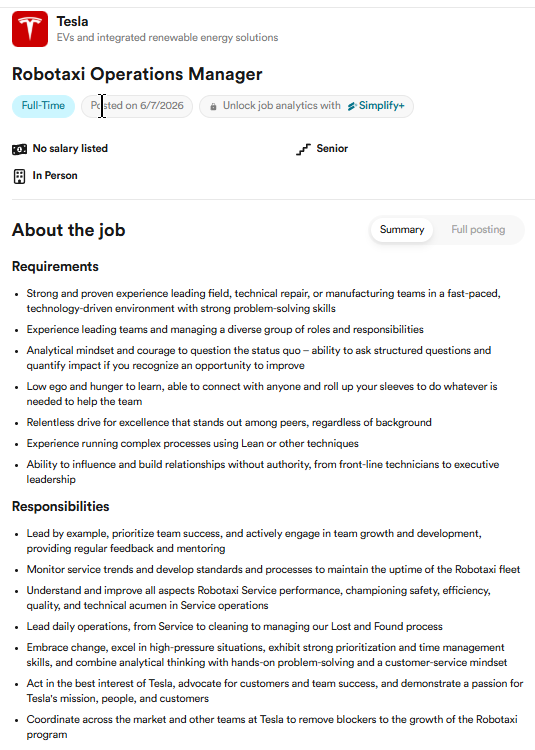
They want somebody who can monitor service trends, develop standards and processes and maintain the uptime of the Robotaxi fleet.
See what just happened?
Your resume stopped being a history of your employment and started becoming evidence that you can solve Tesla’s problems.
That principle works whether you are applying to Tesla, a construction company, a hospital, a bank or the local engineering firm down the road.
How to Turn a Job Description Into Your Interview Blueprint
Here is what I would do next.
Print the job advertisement out. Yes, I know that sounds terribly twentieth century, but humour me.
Take a highlighter and mark every phrase that describes something the successful person must actually be able to do.
In the Tesla advertisement, I would be marking phrases such as leading teams, problem-solving, questioning the status quo, quantifying improvement, Lean processes, influencing without authority, mentoring people, improving uptime, safety, efficiency, quality, prioritisation and removing blockers.
Don’t copy those phrases blindly into your resume.
That isn’t the exercise.
Instead, sit back with a coffee and ask yourself:
“When have I actually done this?”
Now the memories start coming back:
- Perhaps you once inherited a struggling team.
- Perhaps you spotted a recurring fault everybody else had simply learned to live with.
- Perhaps production was continually missing a target and you discovered the bottleneck.
- Perhaps two departments were blaming each other and you brought them together.
- Perhaps you persuaded a senior manager to change something even though you had absolutely no authority over them.
- Perhaps you improved a process using Lean.
- Perhaps you made a mistake, learned from it and changed the way the team operated afterwards.
Those are your stories.
And those stories are potentially far more valuable than your job titles.
Use the STAR Interview Method – But Don’t Forget the Most Important Letter
You may already have come across the STAR interview method.
STAR stands for Situation, Task, Action and Result, and it is closely associated with behavioural interviewing. The idea is wonderfully simple: give the interviewer enough context to understand the situation, explain what needed to be done, describe what you actually did and finish with what happened as a result.
But in my experience, people often spend far too long on the S and T.
They describe the company. They describe the department. They explain the project. They tell you how difficult everything was.
Five minutes later, I’m still waiting to discover what they actually did.
For me, the gold lives in the A and the R.
- What action did you take?
- And what was the result?
If the interviewer has to drag the result out of you, you have buried the most valuable part of your answer.
This is why my old “So what?” question works so well.
“I introduced a new maintenance scheduling process.”
So what?
“It reduced unscheduled downtime by 18% within four months.”
Now I’m listening.
“I coached my supervisors to hold weekly performance conversations.”
So what?
“Absenteeism fell, two supervisors were subsequently promoted and staff turnover reduced by 22% over the following year.”
Now I’m really listening.
The numbers aren’t there to make you sound clever. They give the interviewer evidence.
How to Quantify Achievements on Your Resume Without Making Things Up
This is where some people get stuck because they think every achievement has to involve millions of dollars or a spectacular percentage improvement.
It doesn’t.
You can quantify far more than you probably realise.
Think about time, cost, quality, productivity, defects, downtime, customer complaints, delivery performance, employee retention, response times, safety incidents, backlog, rework, capacity or the number of people you developed.
And if you genuinely don’t have a reliable number, don’t invent one.
Specific evidence is still better than vague boasting.
For example, “Led the introduction of a new escalation process that prevented recurring customer issues from being passed between three departments” tells me much more than “Excellent problem-solving and communication skills.”
Anybody can claim to have excellent communication skills, so show me the occasion when those communication skills actually changed something.
What Tesla’s Robotaxi Job Tells Us About Modern Leadership
There is another reason I like this particular advertisement.
Look at the combination Tesla is asking for:
- They want analytical thinking and hands-on problem-solving.
- They want somebody capable of dealing with executives and front-line technicians.
- They want process discipline and the courage to challenge the existing process.
- They want somebody who can lead without relying on authority.
- And they specifically mention low ego, learning and being willing to roll up your sleeves.
That tells you something very important about how to prepare for the interview.
Don’t walk into that room with six stories about how many people reported to you.
Prepare stories showing how you made things better:
- Have one example of improving a process.
- Have one where you solved a difficult operational problem.
- Have one where you influenced somebody you couldn’t simply order around.
- Have one where the pressure was on and priorities were competing.
- Have one where you developed somebody else.
- And have one where you challenged the way things had always been done and can explain exactly what happened afterwards.
Notice that I said prepare stories, not memorise answers.
There is a big difference.
You want to know your evidence well enough that you can naturally adapt it to the question you are asked.
How to Answer Behavioral Interview Questions Without Sounding Rehearsed
Imagine Tesla asks:
“Tell me about a time you identified an opportunity to improve an established process.”
A weak answer begins with theory.
“Well, I’m a great believer in continuous improvement and I always encourage my teams to challenge the status quo…”
That sounds lovely.
But I still don’t know whether you have ever actually done it.
A much stronger answer begins with reality.
“In my previous operation, we were repeatedly losing around three hours each week because completed equipment was waiting for final inspection. Everybody regarded it as a staffing problem, but when I looked at the data, I realised the real issue was the way work was being batched…”
Now you have me:
- What did you discover?
- What did you change?
- Who did you have to persuade?
- What resistance did you encounter?
- And what happened afterwards?
That is a conversation an interviewer can dig into. And that’s exactly what you want.
Your Resume and Your Interview Should Tell the Same Story
There is another trap worth avoiding.
Some people create a beautifully tailored resume and then turn up at the interview as though the two things have never met.
Don’t do that.
Every significant achievement on your resume should have a story behind it that you can comfortably discuss.
If you say you “improved service efficiency by 27%”, assume somebody is going to ask how.
Good. You should want them to ask because now they have invited you to talk about one of your strongest pieces of evidence.
Explain where the 27% came from. Explain what the problem was. Explain what you personally did. Explain who else was involved. Explain what didn’t work initially if that’s relevant.
A strong resume doesn’t merely get you through the door.
It plants conversation starters for the interview.
The Question I Would Ask Myself Before a Tesla Interview
If I were preparing for this Robotaxi Operations Manager interview, I would put the advertisement on one side of my desk and my resume on the other.
Then I would go through every major requirement and ask:
“Where is my evidence?”
Tesla wants leadership. Where is my evidence?
Tesla wants process improvement. Where is my evidence?
Tesla wants Lean thinking. Where is my evidence?
Tesla wants somebody who can influence without authority. Where is my evidence?
Tesla wants somebody who performs under pressure. Where is my evidence?
Tesla wants somebody prepared to question the status quo and quantify the impact of an improvement. Where is my evidence?
If I couldn’t answer one of those questions, I wouldn’t try to bluff my way around it. I would think harder about my career and look for the closest genuine example I have.
And if I genuinely had no evidence at all for something they regard as fundamental, then perhaps this particular job isn’t the right match.
That is useful information too.
How to Stand Out in a Job Interview When Everyone Looks Qualified
This brings us back to those queues of managers I used to interview all those years ago.
On paper, many of them looked remarkably similar:
- They had managed teams.
- They had attended meetings.
- They had prepared reports.
- They had been responsible for budgets.
- They had implemented company policies.
So had everybody else.
The candidates I remembered were the ones who could tell me what changed because they were there.
They didn’t necessarily have the grandest job title.
They didn’t always come from the biggest company, but when I asked questions, they had evidence.
They could tell me about a real problem, what they personally did about it and what happened as a result.
And because the story was real, I could probe:
- “Why did you choose that approach?”
- “What resistance did you get?”
- “What would you do differently?”
- “How did you measure the improvement?”
- “What did you learn?”
A genuine achievement gets stronger under questioning.
A piece of CV puffery usually falls apart.
The “So What?” Test You Can Use Before Your Next Job Application
So here is something you can do before you send your next application.
Open your resume and read every important statement about your current and previous jobs.
Whenever you see phrases such as “responsible for”, “managed”, “led”, “supported”, “oversaw” or “worked with”, stop.
Then ask: So what?
- What became better?
- What problem disappeared?
- What became faster, safer or cheaper?
- What did customers notice?
- What did your team achieve?
- What changed because you were involved?
You don’t have to delete every description of responsibility. The reader still needs context.
But responsibility tells me what your job was, whereas results tell me whether you were any good at it. And that is a very different thing.
Before You Hit Send on Your Next Resume
Tesla’s Robotaxi Operations Manager advertisement may disappear eventually. Somebody will get the job and the Robotaxi programme will move on.
But the lesson inside that advertisement isn’t going anywhere.
Companies don’t really hire a collection of responsibilities.
They hire people because they have problems to solve, results to achieve, customers to serve, teams to develop and things they want to make better.
Your job application should help them imagine you doing exactly that.
So don’t simply tell your next potential employer what you’ve been responsible for.
Show them what happened because you were there.
Then, when you get the interview, be ready to take them through the Situation, the Task, the Action and – most importantly – the Result.
And before you send that application, give your resume one final read and ask the question that hiring managers have been asking, silently or otherwise, for decades:
So what?
If your resume answers that question before they have to ask it, you have already given yourself a much better chance of being the person they want to meet.
