
If you’re thinking about investing in a professional project management qualification, there’s a good chance you’ve already come across two names that appear regularly in discussions about project management careers.
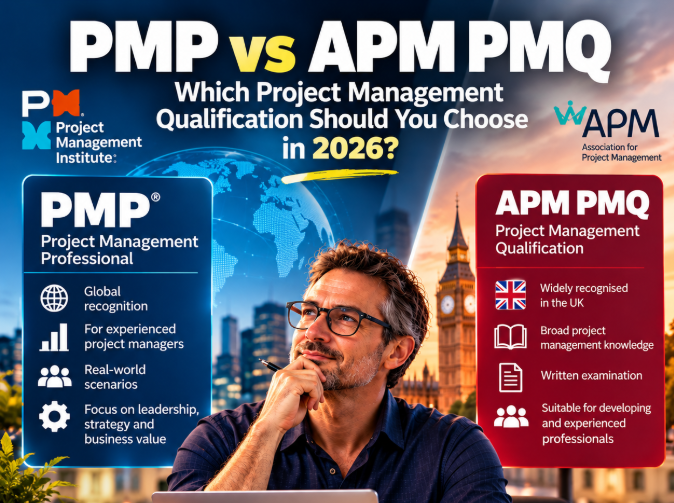
One is the Project Management Professional certification, better known as PMP, awarded by the Project Management Institute (PMI). The other is the Project Management Qualification, or PMQ, awarded by the Association for Project Management (APM).
Both are respected qualifications, both can help demonstrate your project management knowledge, and both are worth considering if you’re serious about developing your career.
But which one should you choose?
Well, having spent many years helping people prepare for professional project management examinations, I think there’s a more useful way to approach that question than simply comparing the number of examination questions or the length of the syllabus.
The real question is what you’re hoping the qualification will help you achieve, because PMP and APM PMQ are designed for somewhat different purposes and professional circumstances.
And choosing the right one could save you considerable time, money and unnecessary frustration.
What Is the Difference Between PMP and APM PMQ?
Let’s begin with the most important distinction.
PMP is a professional certification designed for people who already have substantial experience leading and managing projects. It assesses whether candidates can apply project management knowledge, judgement and experience in realistic situations.
APM PMQ, on the other hand, is a broad project management qualification designed to demonstrate understanding of the principles, processes and practices used to manage projects effectively.
That doesn’t mean APM PMQ is only suitable for beginners, or that PMP is automatically the better qualification.
In fact, I’ve worked with experienced project managers who would benefit enormously from studying APM PMQ because it encourages them to examine the reasoning behind the techniques they’ve been using for years.
Equally, someone who has spent several years managing complex projects may find PMP particularly relevant because it builds upon their practical experience and tests their ability to make appropriate decisions.
The distinction is really about the purpose of the qualification and where you currently stand in your professional development.
Who Should Consider the PMP Certification?
If you’ve already been managing projects for several years, particularly in an international organisation, PMP may be an attractive option.
The certification is recognised across many industries and countries, making it relevant to project managers working in areas such as information technology, engineering, construction, financial services and organisational change.
However, there is something important to understand before rushing into PMP examination preparation.
PMI has specific eligibility requirements, including qualifying project leadership experience and project management education or training. The exact experience requirement depends on your educational background.
In other words, PMP isn’t simply a qualification you can decide to sit because you’ve completed an online course. You need to establish that you’re eligible before applying for the examination.
And there’s another consideration.
The PMP examination doesn’t merely ask candidates to remember project management definitions. It expects them to understand how a project manager should respond when faced with uncertainty, competing priorities, difficult stakeholders and changing business requirements.
Imagine, for example, that a project team discovers a significant technical problem shortly before a major delivery milestone.
One stakeholder wants the team to work overtime, another wants the delivery date postponed, and the sponsor is becoming increasingly concerned about the business implications.
A competent project manager needs to understand the problem, evaluate the available options, engage the appropriate people and recommend a sensible way forward. That’s the kind of professional judgement that PMP examination preparation needs to develop.
How Has the PMP Examination Changed in 2026?
This is particularly relevant for anyone preparing for PMP today because PMI introduced a revised examination in July 2026.
The revised examination places greater emphasis on the wider business environment, including governance, compliance, sustainability, organisational change and the delivery of business value.
The examination continues to cover three major domains: People, Process and Business Environment.
However, their relative importance has changed. People now accounts for 33% of the examination, Process accounts for 41%, and Business Environment accounts for 26%.
That increase in Business Environment is particularly significant because it previously represented just 8% of the examination.
For candidates, this means understanding how projects contribute to organisational objectives is becoming increasingly important.
It also means recognising that delivering the agreed project outputs isn’t necessarily the same as achieving the benefits that justified the investment.
For example, a project might successfully introduce a new software system, complete all its testing and finish within the approved budget. But if the people expected to use that system refuse to adopt it, the organisation may receive very little of the intended business value.
Modern project managers need to understand that distinction, and the revised PMP examination reflects it.
The examination also places greater emphasis on emerging technologies, including artificial intelligence, and on the judgement needed to use those technologies responsibly. If you’re preparing for PMP in 2026, make sure you understand which examination syllabus your training is designed to support.
Who Should Consider the APM Project Management Qualification?
Now let’s turn our attention to APM PMQ.
For people working in the United Kingdom, particularly within organisations that recognise the Association for Project Management’s professional framework, APM PMQ is an excellent qualification to consider.
It covers a broad range of project management knowledge, including governance, planning, risk management, quality, stakeholder engagement, leadership, communication and the management of project resources.
One of the things I particularly like about APM PMQ is that it encourages candidates to understand how these subjects fit together.
Take project risk management as an example. It’s relatively easy to memorise the definition of a risk register or learn the difference between a threat and an opportunity.
But understanding risk management properly means knowing how to identify uncertainty, assess its potential impact, develop appropriate responses and use the resulting information to support project decisions. That’s the difference between simply recognising project management terminology and understanding how to apply it.
APM PMQ also requires candidates to demonstrate their knowledge through written responses rather than relying entirely on selecting answers from a list of options. For some learners, this initially feels more demanding because they need to organise their thoughts and explain their understanding clearly.
However, with appropriate preparation, it can be an effective way to develop confidence in the subject.
And unlike PMP, APM PMQ doesn’t impose the same formal project leadership experience requirements for examination eligibility, although some prior project experience or foundation-level knowledge is certainly helpful.
Is PMP More Difficult Than APM PMQ?
This is a question I hear quite regularly, and I’m always slightly reluctant to give a simple answer.
The difficulty depends on your experience, the way you learn and the type of examination that suits you.
PMP questions frequently present realistic project situations and ask candidates to select the most appropriate response.
You may find that several answers appear reasonable, but only one represents the best professional decision in the circumstances described. That requires careful reading, judgement and an understanding of the principles underlying effective project management.
APM PMQ presents a different challenge because candidates must demonstrate their understanding through written answers.
It’s not enough to recognise the correct terminology when you see it. You need to recall the relevant knowledge and explain it accurately.
Someone who is comfortable analysing scenarios might find PMP’s examination format more natural, while somebody who enjoys explaining concepts in writing might prefer the APM approach.
Neither qualification should be underestimated.
Both require serious preparation, and both reward candidates who understand the subject rather than simply memorise answers.
Which Qualification Is Better for Your Project Management Career?
Here’s where I would encourage you to think about your longer-term career ambitions.
If you’re an experienced project manager working in an international environment, PMP may provide a particularly relevant professional credential.
If you’re developing your project management career in the UK, or working for an organisation that values the APM framework, APM PMQ may be the more appropriate choice.
However, I wouldn’t make the decision based entirely on geography.
Many organisations employ people from different professional backgrounds and use a mixture of project management approaches.
The qualification that carries the greatest value for you will depend on the employers you want to work for, the responsibilities you hope to undertake and the experience you’ve already gained.
It’s worth looking at actual job advertisements for the positions that interest you.
Do employers mention PMP? Do they ask for APM qualifications? Are they more concerned about your practical experience, leadership capabilities or knowledge of particular delivery approaches?
Those answers can help you make a much more informed investment decision. And remember that professional qualifications aren’t necessarily competing alternatives.
Some project managers choose to pursue more than one qualification during their careers because each provides a different perspective and helps develop their professional knowledge.
Can AI Help You Prepare for PMP or APM PMQ?
Artificial intelligence is becoming increasingly useful in professional education, and project management examination preparation is no exception.
AI tools can help explain difficult concepts, generate examples, explore alternative answers and provide additional opportunities to test your understanding.
For example, suppose you’re struggling to understand the difference between a project risk and a project issue.
An AI assistant could explain the distinction, provide practical examples and then ask you questions to check whether you’ve understood it.
That’s potentially very helpful. However, there’s an important limitation. AI-generated explanations and examination questions aren’t automatically accurate or aligned with the latest examination syllabus.
A plausible-sounding answer can still be wrong, particularly when dealing with professional terminology, examination rules or subtle differences between project management approaches.
This is why I believe AI works best as a supporting learning tool rather than a substitute for properly structured training.
A good course should provide a logical learning pathway, explain the important concepts, help you understand how they connect and prepare you for the style of examination you’re going to face.
AI can then supplement that learning by helping you explore areas where you need additional practice.
How to Choose an Online PMP or APM PMQ Training Course
Once you’ve decided which qualification is right for you, the next challenge is choosing an appropriate training course. There are plenty of options available, and prices can vary enormously.
Some courses concentrate almost entirely on examination questions, while others provide extensive explanations of project management concepts and practical examples. Personally, I’ve always believed that examination preparation should begin with understanding.
If you understand why a particular project management approach is appropriate, you’re far better equipped to answer questions that present unfamiliar situations. That matters particularly for PMP, where the examination tests professional judgement, and for APM PMQ, where candidates must explain their knowledge in written responses.
I’d also encourage you to consider how you prefer to learn. Some people enjoy attending classroom courses, while others prefer studying online at their own pace, returning to difficult subjects whenever they need additional explanation.
Online training can be particularly convenient for people who are already working full-time or managing family commitments.
And if you’re considering more than one qualification, access to a broader training library may provide better value than purchasing several unrelated courses separately.
Explore PMP and APM PMQ Training at Projex Academy
At Projex Academy, we’ve spent many years developing online project management training designed to make professional qualifications more accessible and easier to understand.
Our training library includes dedicated PMP and APM PMQ Masterclasses, together with other professional development courses covering subjects such as PRINCE2, Scrum and Lean Six Sigma.
Rather than simply presenting lists of terminology, I aim to explain project management in the same way I would when teaching somebody sitting in front of me. That means discussing the reasoning behind the methods, exploring practical examples and helping learners understand how individual topics contribute to successful project delivery.
It’s an approach I’ve developed over many years of working with project managers and helping candidates prepare for professional examinations.
Our membership provides access to a range of project management learning resources, allowing you to develop your knowledge at a pace that suits your circumstances.
If you’re planning to prepare for PMP or APM PMQ, or simply want to strengthen your understanding of modern project management, I invite you to explore what Projex Academy has to offer.
Explore Projex Academy Membership and Start Learning
My Final Advice: Choose the Qualification That Fits Your Future
When people ask me whether PMP or APM PMQ is the better qualification, my answer is usually that we need to understand a little more about their circumstances before making that decision.
A qualification that makes perfect sense for an experienced international project manager may not be the most appropriate starting point for somebody moving into project management for the first time.
Likewise, someone developing their career within a UK organisation may find that APM PMQ aligns particularly well with their employer’s expectations and professional development framework.
The important thing is to make your decision based on where you are now and where you want your career to take you. And whichever qualification you choose, don’t regard the examination as the end of your professional development.
Project management continues to evolve, particularly as artificial intelligence, sustainability, digital transformation and changing business expectations influence the way organisations deliver projects.
The most effective project managers are those who continue developing their knowledge and applying what they’ve learned.
That’s what professional development should really be about, and if Projex Academy can help you along that journey, I’ll be delighted to welcome you.
Dave Litten
Project Management Trainer and Founder of Projex Academy
