The problem with pretending we know the future
Have you ever been handed a project plan that describes, in magnificent detail, what everybody will be doing eleven months from now? There are dates, names, coloured bars and perhaps enough spreadsheet cells to wallpaper the kitchen.
It looks reassuring. The awkward question is whether anyone genuinely knows enough today to make those distant promises.
PRINCE2 offers a sensible answer through its principle of manage by stages and the idea of planning horizons. We plan the whole project sufficiently to understand its direction, justification and major commitments.
We plan the work immediately ahead in much greater detail. Then, as the project progresses and uncertainty reduces, we plan the next stage using what we have learned.
In this article I want to explain what a planning horizon means, how it connects to management stages, why it is not an excuse for vague planning, and how to apply it to a realistic project. I will also show you what to look for in PRINCE2 Foundation and Practitioner questions.
What is a planning horizon?

A planning horizon is the distance into the future over which we can plan with a useful degree of confidence. Near-term work is usually clearer because we know more about available people, suppliers, requirements and constraints. Further ahead, our assumptions multiply.
Imagine driving on a winding road at night. Your headlights show enough of the road to make the next safe decisions, not every bend between your house and Edinburgh.
You still need to know where Edinburgh is and why you are going there. You simply do not need to pretend that every bend is visible before leaving the driveway.
That is the spirit of planning horizons. It is not a recommendation to begin a project without an overall plan. PRINCE2 distinguishes the project plan, which gives the overall picture, from the more detailed stage plans that support day-to-day control.
Manage by stages is a governance decision
A management stage is a section of the project for which the project board authorises work and delegates authority to the project manager.
At a stage boundary, the board can review performance, reconsider the business case and decide whether the next investment is justified.
This is different from a technical phase. Design, construction and testing may overlap, while a management stage is fundamentally a decision and control period.
A small project may need relatively few stages. A complex or uncertain one may need more. PRINCE2 requires at least an initiation stage and one delivery stage.
The important thing is to create useful decision points, not to divide the calendar into neat slices merely because somebody likes tidy quarters.
Fictional example: building the Riverside Café
Let us use a fictional project to build and open a small neighbourhood café. The sponsor wants a welcoming venue with accessible facilities, efficient equipment and a sustainable operating model. The target opening is next summer.
At initiation, the project manager can develop an overall project plan showing the intended outcomes, major products, indicative budget, significant dependencies and likely management stages. That is enough to test whether the proposal is plausible and to give the board a basis for control.
But suppose the team tries to produce a minute-by-minute installation schedule for the espresso equipment nine months ahead.
The electrical layout has not been finalised, the supplier has not been selected and the landlord’s access arrangements are still under discussion. The apparent precision is theatre, not reliable planning.
Stage one: confirm the design and approvals
The first delivery stage concentrates on completing the café design, checking permissions, confirming key requirements and selecting suppliers. This work can be planned in detail because the tasks and immediate dependencies are reasonably well understood.
The stage plan identifies the products to deliver, activities, resources, responsibilities, controls and tolerances. It also makes the assumptions visible. If planning consent is uncertain, that uncertainty belongs in the risk management work, not hidden behind an optimistic date.
At the boundary: use new evidence
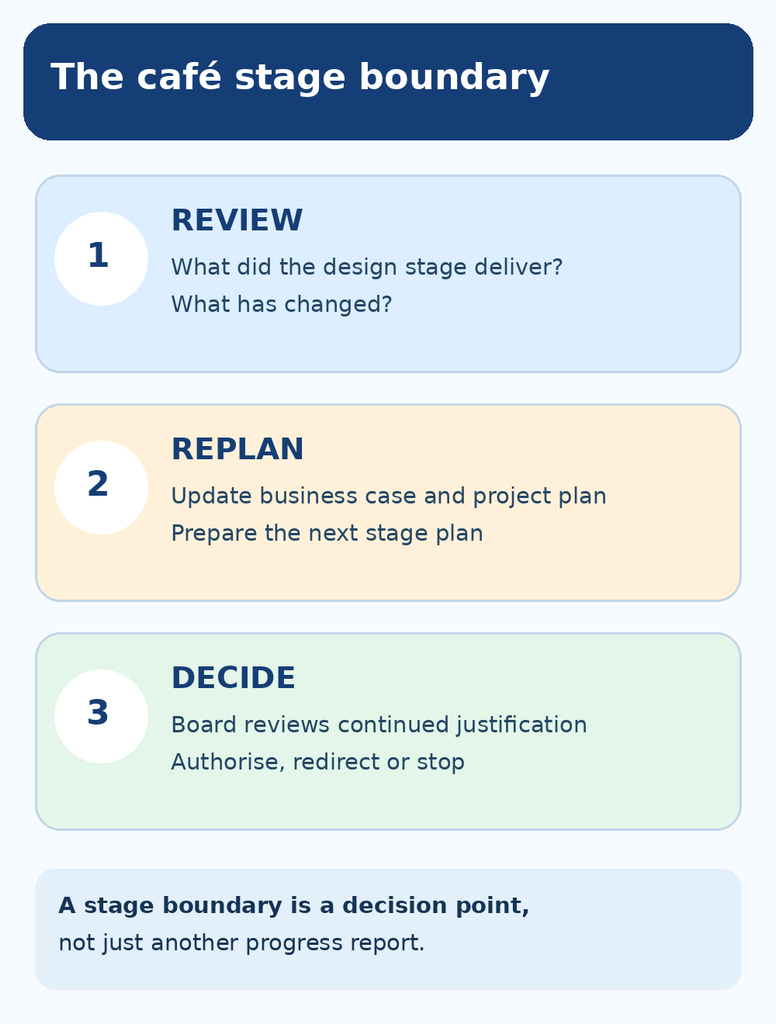
By the end of this stage, the team has approved drawings, supplier quotations and a better understanding of access constraints. The project manager prepares an end stage report and a detailed plan for the next stage, updates the project plan and business case as appropriate, and presents the information needed for the project board’s decision.
The board can now decide whether to authorise the next stage. It is not merely rubber-stamping work already started. It is checking whether the project remains worthwhile, viable and achievable, and whether the proposed next stage is an acceptable commitment.
Stage two: fit-out and equipment installation
Now the team can plan the fit-out with considerably greater confidence. There are actual suppliers, approved layouts and agreed site arrangements. The detailed schedule is no longer based on a collection of hopeful guesses.
Notice that the project plan still covers the journey towards opening. The next stage plan simply gives the team the detailed instructions and controls it needs for the work currently being authorised.
The three planning mistakes I see most often
Mistake one: confusing detail with certainty
A plan with 600 activities is not automatically more dependable than one with 60. Ask what evidence supports the dates and dependencies. If the evidence is weak, additional decimal places do not improve it.
A useful habit is to label assumptions and identify the decisions that could change them. That helps the project manager distinguish a genuine commitment from a working estimate.
Mistake two: treating stage boundaries as paperwork
A stage boundary is an opportunity to reassess the project, not simply to produce another report for the filing cabinet. What have we learned? What has changed? Do the expected benefits still justify the remaining cost and risk? Does the next stage plan deserve approval?
If the answers are never discussed, the project may be governed in name only.
Mistake three: starting the next stage before authorisation
The pressure to keep people busy can be enormous. But allowing significant next-stage work to begin before the board has made its decision undermines the control that management stages are meant to provide.
Prepare the next stage plan in good time, give the board usable information, and make the authorisation decision explicit. Good governance should be timely, not theatrical.
Five practical steps for using planning horizons
First, establish the overall destination. Define the project products, intended outcomes, important milestones, business justification and principal constraints. You need a credible project-level picture even when the later detail remains uncertain.
Second, choose management stage boundaries that matter. Useful boundaries may follow major decisions, important external approvals, shifts in risk or significant investment commitments. Do not confuse them automatically with specialist work phases.
Third, plan the immediate stage in sufficient detail to manage it. Identify products, work, responsibilities, resources, dependencies, reporting and tolerances. The plan should enable decisions, not simply look impressive on a screen.
Fourth, monitor what is changing. Maintain relevant risk and issue information, check progress against the stage plan, and keep the project-level forecast current. New information should improve the next decision, not remain trapped in someone’s notebook.
Fifth, use the boundary as a genuine review. Evaluate the current stage, update the business case and overall plan as necessary, prepare the next stage plan, and seek the project board’s authorisation. If the project is no longer justified, stopping or redirecting it may be the responsible decision.
How this helps with PRINCE2 examinations
For Foundation, understand the purpose of the manage by stages principle, the difference between project and stage plans, and the reason for reviewing continued business justification at stage boundaries.
Be clear that the project board authorises stages while the project manager manages the authorised stage within delegated tolerances.
For Practitioner, think about the scenario rather than hunting for a memorised phrase. Suppose a project has uncertain supplier lead times but the next stage involves only design approval. Would it be sensible to demand a fully detailed installation schedule now? Usually not.
A better approach is to retain a credible overall project plan and develop the installation detail when the relevant information is available and that stage is being prepared.
Equally, do not choose an answer that avoids planning altogether. PRINCE2 combines a whole-project view with progressive detail and formal control. Both elements matter.
One examination trap is to confuse a stage boundary with an exception. An exception concerns a forecast breach of delegated tolerance and follows its own escalation and decision arrangements. A normal stage boundary is a planned review and authorisation point. Both may involve the project board, but they are not the same event.
Always use the current official syllabus and candidate guidance for examination arrangements rather than relying on an old practice paper or a third-party summary.
What I want you to remember
Planning horizons are about being realistic with uncertainty. A project manager should know the destination, understand the immediate road and keep checking whether the journey still makes business sense.
The next stage deserves more detailed planning because we know more about it. The distant stages deserve enough planning to make the overall investment credible, without pretending to know what has not yet been discovered.
That balance is one of the practical strengths of PRINCE2. It gives the project board meaningful control without requiring the team to predict the unknowable.
If you are preparing for PRINCE2 Foundation or Practitioner, you can explore the Projex Academy PRINCE2 Masterclass, where I teach how the principles, practices and processes fit together.
Whether or not you are studying for an examination, try asking one question at your next planning meeting: Are we planning this work at the level of detail the evidence actually supports?

