
Most people who discover Lean Six Sigma are introduced to DMAIC fairly quickly.
Define the problem, Measure what is happening, Analyse the causes, Improve the process and then Control the improvement so that the gains don’t quietly disappear six months later
It’s a remarkably powerful approach, and there’s a good reason why DMAIC sits at the heart of Lean Six Sigma.
But there is a question that doesn’t get asked nearly often enough.
What happens when there isn’t an existing process to improve?
Perhaps you’re developing a completely new product or service. Maybe you’re creating a new business process that has never existed before. Or perhaps there is an existing process, but when you examine it properly you discover that it is so fundamentally unsuitable that continually trying to improve it makes little sense.
That’s a very different problem.
And it’s where Design for Six Sigma, usually shortened to DFSS, enters the picture.
DMAIC and DFSS Solve Different Problems
The easiest way to understand Design for Six Sigma is to begin with the problem DMAIC was designed to solve.
DMAIC works brilliantly when you already have a process but its performance isn’t good enough. Perhaps it produces too many defects, takes too long, costs too much, creates excessive variation or regularly disappoints customers.
There is something there for us to investigate.
We can measure the existing process, understand how it performs, analyse what is causing the problems and improve it.
ASQ describes DMAIC in essentially those terms: a structured approach for improving an existing process that isn’t meeting performance standards or customer expectations.
But imagine that instead of improving an existing customer-service process, your organisation is about to launch an entirely new online service.
What exactly are you going to Measure and Analyse?
There isn’t an established process yet.
Alternatively, suppose you do have an existing process, but years of changes, workarounds, extra approvals and patched-in systems have left it resembling something that has been repaired so many times that nobody can remember what the original design was supposed to achieve.
You could keep improving individual parts of it.
Or you could ask a much more useful question:
If we were designing this properly today, knowing what we now know about our customers, how would we build it?
That is DFSS territory.
Design Quality In Rather Than Fixing Problems Later
For me, this is the idea that makes Design for Six Sigma particularly interesting.
Traditional improvement begins with something that already exists. We observe its performance, find the weaknesses and make it better.
DFSS tries to move that thinking upstream.
Instead of waiting for a product, service or process to be launched and then discovering that it doesn’t consistently satisfy the customer, we use Six Sigma thinking while we’re designing it.
ASQ describes DFSS as being used to design new products or processes so that Six Sigma quality is considered from the beginning, while its DFSS material emphasises designing around customer needs rather than trying to correct shortcomings afterwards.
That change of perspective is important.
If we can understand what matters to the customer before we commit ourselves to a design, translate those needs into meaningful requirements and then test whether our proposed design can reliably achieve them, we have a much better chance of getting things right before expensive problems become embedded in the finished product or process.
That’s considerably more attractive than discovering the weaknesses after launch and starting a major improvement project to remove problems we could perhaps have prevented.
From DMAIC to DMADV
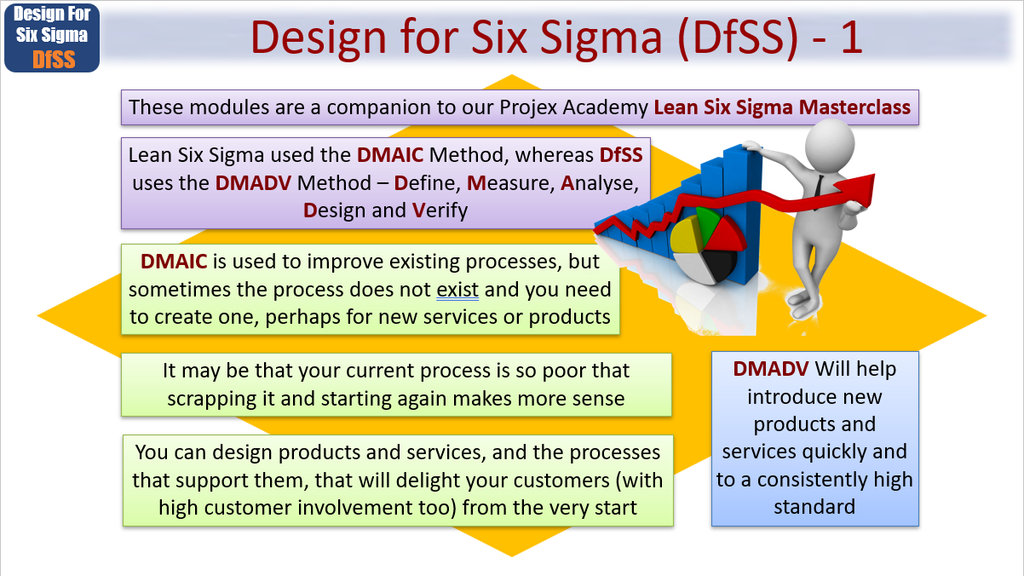
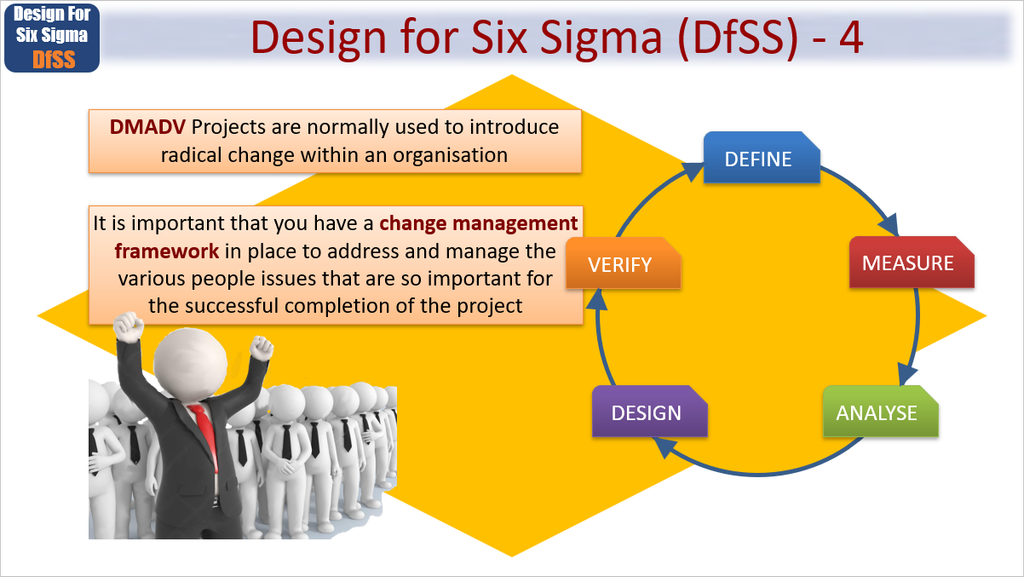
If DMAIC gives us the road map for improving an existing process, one of the most widely used road maps for Design for Six Sigma is DMADV: Define, Measure, Analyse, Design and Verify.
This currently teaches DFSS through this DMADV structure, although DFSS is broader than any single road map and other approaches also exist.
At first glance, DMAIC and DMADV look remarkably similar because both begin with Define, Measure and Analyse.
But look at what happens towards the end.
DMAIC moves from Analyse into Improve and Control because we already have something that we’re trying to make better.
DMADV moves from Analyse into Design and Verify because we’re creating the solution rather than improving the existing one.
That difference tells you a great deal about the thinking behind DFSS. We’re not asking how to repair today’s process.
We’re asking what tomorrow’s process should look like.
Define What You Are Really Trying to Create
The Define stage establishes why the new product, service or process is needed in the first place.
That sounds obvious, but poorly defined requirements have caused an extraordinary amount of wasted effort over the years.
It is very easy for an organisation to jump from recognising a need straight into designing a solution. Somebody identifies a problem, somebody else has a clever idea and before long a team is building something.
DFSS encourages us to resist that temptation.
Before designing the solution, we need to understand the business opportunity, the customer, the objectives and the boundaries within which the design must operate.
That gives the team something much more useful than an interesting idea – it gives them a design challenge they actually understand.
Measure What Matters to the Customer
This stage can initially seem confusing because we’re talking about designing something new. If the process doesn’t exist yet, what exactly are we measuring?
We’re measuring and translating customer needs and requirements.
This is where Voice of the Customer becomes enormously important.
Customers don’t normally speak in engineering specifications or statistical measures. They tell us what they want in everyday language. They want something to be fast, easy, reliable, safe, affordable or convenient.
Those statements matter, but they aren’t yet precise enough to design against.
The DFSS challenge is to translate what the customer values into requirements that can actually influence the design.
ASQ’s DMADV description specifically places capturing Voice of the Customer and establishing specifications within this Measure phase.
Now we’re beginning to design around what the customer genuinely needs rather than what the organisation assumes the customer wants.
That can save an awful lot of expensive surprises later.
Analyse Before Falling in Love With a Solution
This is another area where disciplined thinking matters.
Once people start designing something, they become attached to their ideas surprisingly quickly.
Somebody produces a clever concept and suddenly the conversation changes from “What is the best solution?” to “How do we make my solution work?”
DFSS gives us a reason to hold back.
During Analyse, we can develop and compare alternative concepts and determine which design approach is most likely to satisfy the requirements we’ve established. That means the decision isn’t based simply on which idea sounds most exciting in the meeting.
We’re asking which design best satisfies the customer and business requirements while remaining practical, reliable and capable of being delivered.
It’s a subtle change, but an important one.
Design It Before You Build It
Once the preferred concept has emerged, we can move into detailed Design.
Now the solution begins to take shape.
Depending on what we’re creating, that might involve modelling, simulation, prototypes, pilot processes, detailed specifications or other techniques that allow us to understand how the proposed design will behave before we commit to full implementation.
This is one of the places where DFSS can save an organisation a great deal of money.
Changing a design while it is still a model or prototype is usually much easier than changing it after you’ve built factories, written software, trained hundreds of people or launched something to thousands of customers.
ASQ’s current DMADV guidance explicitly includes techniques such as pilot runs, simulations, prototypes and models as ways of demonstrating that the detailed design can meet its requirements.
In other words, we’re trying to discover the problems while they’re still relatively cheap to fix.
Verify That the Design Actually Works
Eventually we reach Verify. This is where we stop asking whether the design should work and gather evidence that it actually does:
- Does the finished product, service or process satisfy the requirements we established earlier?
- Does it perform reliably?
- Does it deliver what the customer needs?
- Can it operate successfully under real-world conditions rather than merely looking good on the design team’s whiteboard?
Verification closes an important loop.
We began by asking what the customer needed, translated those needs into requirements, developed and selected a design and then built it.
Now we return to those original requirements and demonstrate that the finished design meets them.
That’s a much stronger position than launching something and waiting for customer complaints to tell us where the design went wrong.
How Do You Know Whether to Use DMAIC or DFSS?
This is the practical question I would want you to remember.
If you have an existing process that fundamentally does what it is supposed to do but isn’t performing well enough, DMAIC is usually the natural starting point.
You have something to measure, analyse and improve.
If you’re creating something genuinely new, DFSS becomes the more natural approach because you’re trying to design quality and performance into it from the beginning.
There is also an important middle ground. Sometimes an existing process is performing so badly, or has become so unsuitable for what the organisation now needs, that improving it would amount to continually repairing the wrong solution.
ASQ makes precisely this distinction: DMAIC is suited to incremental improvement of an existing process, while DMADV can be used for new products or services or where an existing process requires a complete overhaul.
That’s why I wouldn’t make the decision simply by asking whether a process already exists. I’d ask whether the existing process is worth improving.
Sometimes the smartest improvement is a redesign.
DFSS Isn’t Just for Manufacturing
The word design can make DFSS sound as though it belongs exclusively to engineers designing physical products.
It doesn’t.
The same thinking can be applied to services and business processes. ASQ’s own DFSS material discusses its application to both products and services, including areas far removed from traditional manufacturing.
Think about designing a new online customer-service process, an insurance claims service, a hospital admissions process, a logistics system or the onboarding journey for new employees.
All of those have customers or users.
All have requirements.
All involve design decisions.
And all can suffer if we create the process around what is convenient for the organisation rather than what produces the outcome the customer actually needs.
DFSS gives us a disciplined way of thinking about those decisions before the process becomes established and difficult to change.
Why Voice of the Customer Matters So Much
If I had to pick one idea that sits at the heart of good Design for Six Sigma, it would be this: don’t design what you think the customer wants when you can discover what the customer actually needs.
That sounds obvious. In practice, organisations get it wrong all the time.
We become fascinated by features, technology and clever solutions. Meanwhile, the customer may simply want something easier to use, more reliable or less frustrating.
DFSS forces us to bring those needs into the design process early enough for them to make a difference.
That’s one reason tools such as Quality Function Deployment can become valuable. They help translate customer needs into characteristics and requirements that the design team can actually work with.
ASQ specifically includes QFD within its current DFSS training for precisely this purpose.
The result is a subtle but powerful change.
Instead of designing something and asking whether the customer likes it afterwards, we’re allowing customer requirements to influence what gets designed in the first place.
How Design for Six Sigma Fits With Lean Six Sigma
I don’t see DMAIC and DFSS as competing methodologies.
They solve different problems.
Lean Six Sigma gives us a disciplined approach for understanding and improving existing processes. DFSS extends that thinking into the world of design.
In fact, my own Lean Six Sigma Masterclass at Projex Academy introduces this decision explicitly. If an existing process can sensibly be improved, DMAIC provides the improvement route.
If we’re designing something new – or the existing process is so badly broken that starting again makes more sense – we move into Design for Six Sigma. Projex Academy
That creates a useful professional toolkit.
We don’t begin with a favourite methodology and try to force every business problem into it. We begin with the problem and choose the approach that fits.
Learning Design for Six Sigma at Projex Academy
That’s why I created my separate Design for 6 Sigma Masterclass as a companion to the Lean Six Sigma Masterclass.
The course takes the next step into the design environment and works through the DMADV method: Define, Measure, Analyse, Design and Verify. Projex Academy
The purpose isn’t to teach another five-letter acronym simply for the sake of remembering it – I want you to understand the change in thinking.
With DMAIC, you’re standing in front of an existing process asking, “Why isn’t this performing as well as it should, and how can I improve it?”
With DFSS, you’re standing in front of a blank sheet of paper asking, “What does the customer need, and how can we design something capable of delivering it reliably from the beginning?”
Once you understand that distinction, the relationship between Lean Six Sigma and Design for Six Sigma becomes much clearer.
Your returning to the office test.
So here’s my Monday morning test for deciding whether you’re looking at a Lean Six Sigma improvement problem or a Design for Six Sigma problem.
I
magine somebody puts a troublesome process in front of you.
Don’t immediately reach for DMAIC simply because that’s the methodology you know.
Spend a little time understanding what you’re looking at and ask yourself whether the basic process is sound enough to improve.
If it fundamentally does the right job but needs to do it faster, more reliably, with less waste or with fewer defects, then DMAIC probably gives you the journey you need.
But if there is no existing process, you’re developing a completely new product or service, or the current process is so fundamentally unsuitable that improving it would merely preserve a poor design, change the question:
Don’t ask: “How can we improve this?” Ask: “What should we design instead?”
That’s the point where Design for Six Sigma stops being another piece of quality terminology and becomes an extremely practical way of thinking.
And perhaps that’s the simplest distinction of all.
Lean Six Sigma helps us make an existing process better. Design for Six Sigma helps us make the new process better from the beginning.
