
A greener project can still go badly wrong
Imagine that your project is refurbishing a public library. The building must reopen on time, stay within its agreed budget and use less energy for years to come. Then your supplier announces that the specified insulation is unavailable. The replacement is cheaper and can arrive tomorrow, but it will not achieve the expected energy performance.
Do you protect the schedule, spend more, or ask the project board to decide? This is where PRINCE2 becomes useful.
In this article, we’ll explore what a sustainability target is, how a sustainability tolerance gives a project manager room to act, when a forecast becomes an exception, and how to handle the trade-offs without turning every decision into a committee meeting. You’ll also see a fictional example and examination pointers.
Why sustainability belongs in project control
PRINCE2 Project Management (Version 7), often called PRINCE2 7, treats sustainability as one of seven aspects of project performance. The others are benefits, cost, time, quality, scope and risk. It belongs in the definition of success and the project’s controls.
PeopleCert’s explanation of the seventh edition makes an important distinction: sustainability concerns how the project is delivered and the whole-life sustainability of what the project produces. An efficiently built library can still be costly to heat. A low-energy library can still be delivered wastefully.
Project delivery versus the product’s working life
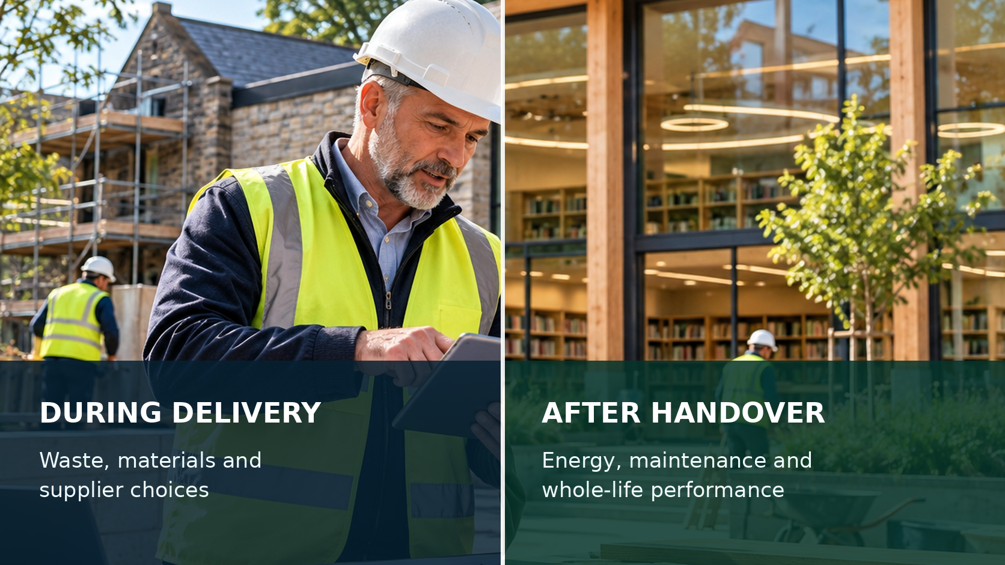
Sustainability during delivery and after handover.
For the library refurbishment, delivery sustainability might include the amount of material sent to landfill, transport arrangements and responsible purchasing. Product sustainability might include future energy consumption, maintenance requirements and the ability to keep the library useful over time.
One concerns today’s work; the other concerns what we hand over. Both matter.
The sustainability management approach explains how the agreed targets will be measured, reviewed and controlled. The business case explains why the project remains worthwhile and records relevant sustainability targets and tolerances. Keep the approach proportionate.
Targets, tolerances and forecasts: three different things
Let’s separate three terms that are often mixed together.
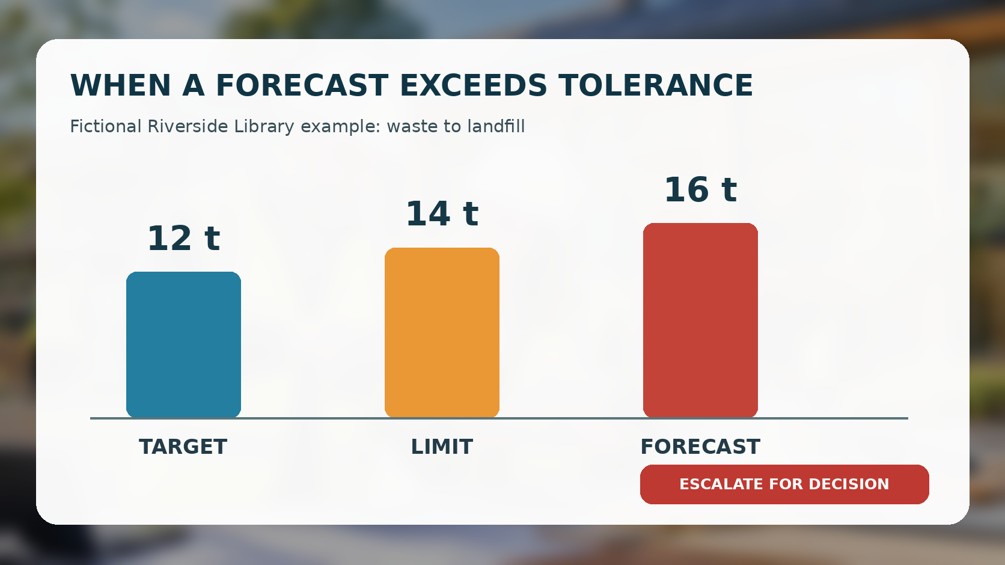
A target is the result you are trying to achieve. For example, the project might aim to send no more than 12 tonnes of construction waste to landfill.
A tolerance is the permitted deviation from an agreed target before a decision must be escalated to the next management level. For example, the project board might allow the project manager an additional 2 tonnes. The target remains 12; the tolerance defines delegated authority.
A forecast is the best current estimate of where the project is heading. You do not wait until the waste skips have actually reached 15 tonnes before telling somebody. If reliable evidence shows the stage is likely to exceed its agreed limit, that forecast calls for action now.
This is PRINCE2’s manage by exception principle at work. The project board delegates authority within tolerances. The project manager manages within those limits. When a forecast indicates that a tolerance will be exceeded, the matter goes to the appropriate higher level for a decision. The same applies to team managers and work packages.
Fictional example: Riverside Library refurbishment
The project, organisation, figures and decisions below are fictional and are used only to demonstrate the method.
Riverside Council has approved a library refurbishment. The business case expects a more comfortable building with lower operating energy demand. The project board has agreed a delivery-stage waste target of 12 tonnes to landfill, with an upper tolerance of 14 tonnes. The project manager also has an agreed stage budget tolerance.
Halfway through the stage, the contractor reports that demolition waste is higher than estimated. The latest evidence points to 16 tonnes by the end of the stage.
The forecast, not the actual waste so far, exceeds the 14-tonne limit. Waiting for the final skip would make escalation useless.
First, investigate the forecast
The project manager asks the team to check the figures. Are waste categories measured consistently? Can materials be salvaged or separated? What would recovery cost, and would it affect safety, quality or time?
Suppose a revised sorting arrangement could reduce the forecast to 13 tonnes without exceeding other tolerances. The project manager may be able to authorise that corrective action within the authority already delegated. The forecast would then return inside the agreed limit
But suppose the credible forecast remains at 16 tonnes. Now the project manager should escalate the exception with the evidence and realistic options. The board can consider options, approve changes within its authority or seek a business-level decision. The important point is that the project manager must not quietly redefine the target.
Next, consider the insulation decision
A second issue appears. The originally specified insulation cannot be supplied in time. A readily available substitute would reduce the estimated energy saving from the agreed 25% target to 15%. A better-performing alternative could preserve the target but add €18,000, which is beyond the project manager’s remaining cost tolerance.
Here, a sustainability decision has become a genuine business decision. Accepting the cheaper product may undermine the future operating benefits. Buying the better product may threaten the authorised budget. Neither option should be approved simply because it is convenient for today’s schedule.
The project manager should assess the issue against the approved product specifications, the business case and all relevant tolerances. The decision belongs with the person or body that has the necessary authority. If a stage tolerance is forecast to be exceeded, that means escalation rather than a quiet adjustment to the spreadsheet.
These percentages are illustrative estimates, not measured results. Real forecasts need a baseline, credible modelling, acceptance checks and post-handover verification.
Make sustainability measurable before you need a decision
Sustainability control falls apart when the target is something vague such as ‘make the building greener’. What would anybody actually measure?
Start with a clear measure, a baseline and a unit. For construction waste, define what counts as landfill waste, where the data will come from and how often it will be reviewed. For operational energy, define the baseline building performance, the assumptions behind any model and who will check the outcome after the library reopens.
Agree the owner, evidence source, corrective-action authority and escalation trigger. Put the measures in normal progress reports. A dashboard nobody reads is decoration.
Keep a simple evidence trail
For a modest project, a short record might show the measure, target, tolerance, current actual, forecast, owner, source of evidence and next action. Scale the evidence to the project, but keep decisions traceable.
Remember that a sustainability measure may be a firm legal or contractual requirement. Such a requirement is not automatically negotiable just because a project manager has a tolerance elsewhere in the plan. Escalation does not give anyone permission to ignore the law or an agreed safety standard.
Five practical steps when a sustainability forecast slips
- Check the evidence. Confirm that the measure, baseline and forecast are reliable. Bad data can make poor decisions look scientific.
- Understand the wider effect. Look at cost, time, quality, scope, risk and benefits alongside sustainability. Improving one target can damage another. The business case should help make the trade-offs visible.
- Find recovery options. Ask the people doing the work what can realistically change. Ask suppliers, users and specialists, not just spreadsheets.
- Decide at the right level. Act within delegated authority where the forecast can be brought back inside tolerance. Escalate promptly when a tolerance is forecast to be exceeded. Provide options and a recommendation, not merely a red traffic light.
- Update and follow through. Record the authorised decision, revise the relevant plan or product information as required, communicate the change and monitor whether the chosen action works.
Common mistakes and how to avoid them
The first mistake is treating sustainability as publicity. If measures do not influence procurement and decisions, a green brochure is not project control.
The second is confusing a target with a tolerance. Being permitted to deviate does not mean the original target has been abandoned. Keep both visible and explain which figure is being reported.
The third is escalating too late. PRINCE2 is concerned with forecast exceptions. A project manager who waits for the breach to happen has thrown away the chance to prevent it.
The fourth is ignoring the product’s working life. A low purchase price can disguise years of high operating costs or difficult maintenance. Compare options against the agreed business case, not merely the supplier’s invoice.
Finally, avoid inventing measurements to fill empty boxes. If the data is uncertain, say so, explain the assumptions and seek the expertise needed to make a responsible decision.
What Foundation and Practitioner candidates should remember
For Foundation, understand why sustainability is one of the seven performance aspects, what the sustainability management approach is for, what tolerance means and how manage by exception operates. Learn the difference between a target, a forecast and the authority to decide.
For Practitioner, expect to apply those ideas to a scenario. A useful question to ask is: What does the latest forecast say, and who has authority to decide? If the project manager can recover within tolerance, normal corrective action may be appropriate. If a stage tolerance is forecast to be exceeded, escalation is required. Do not assume the cheapest or fastest choice is automatically the best answer.
The examination emphasis here is teaching guidance, not a claim about the wording or frequency of questions in a particular paper. Always revise against the current official syllabus and learning materials for your examination.
The lesson to take into your next project
A sustainability target becomes useful when people can measure it, forecast it and make decisions against it. The real strength of PRINCE2 is not that it produces more documents. It is that it helps the right people make timely decisions, with a clear understanding of what they have been authorised to do.
So, on your next project, choose one sustainability measure that genuinely matters. Agree its target, tolerance, owner and review method. Then ask what you will do if the forecast moves outside the agreed limit. That simple conversation can save an awful lot of trouble later.
If you would like to explore the wider method, the Projex Academy PRINCE2 Foundation Masterclass and PRINCE2 Practitioner Masterclass offer structured learning and practical examples. Start with the level that suits your experience and put the ideas to work on a real project.
